SCA1ATXN1
Often broader than balance
May include swallowing difficulty, spasticity, neuropathy, weakness, and abnormal eye movements.
 ThisPhase
NEW NORMAL
It is a neurological sign—not one diagnosis. Understanding the pattern and cause helps shape what comes next.
THE BASICS
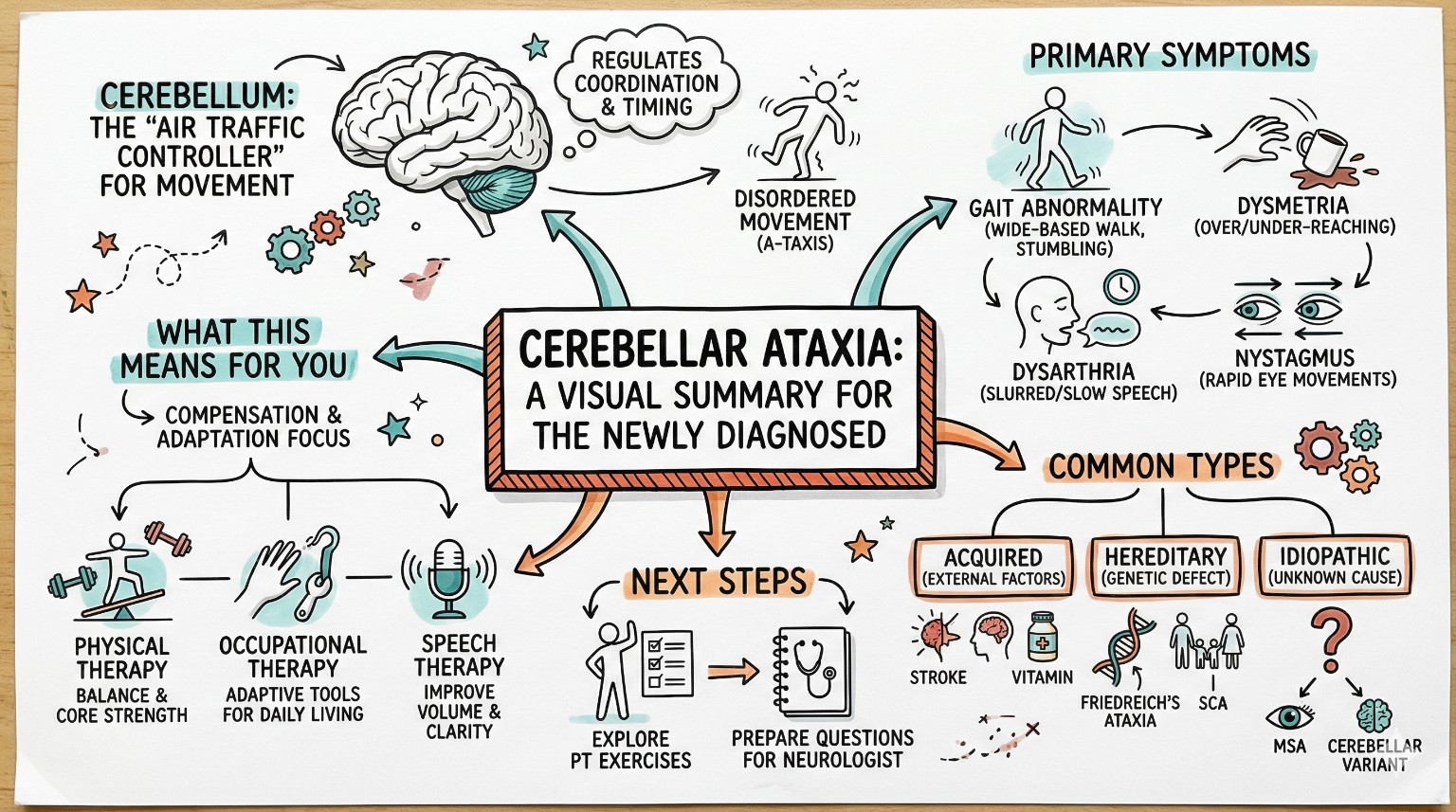
Ataxia may affect walking, balance, hand movements, speech, swallowing, or eye movements. It can be inherited or acquired, sudden or gradual, and stable or progressive.
Because causes differ, a careful medical evaluation matters. Testing may include a neurological examination, imaging, blood work, genetic testing, or other studies based on the history.
My diagnosis is idiopathic cerebellar degeneration attributed to an autoimmune condition involving CASPR2. It is an ultra-rare disease with ~1000 cases worldwide.
NEWLY DIAGNOSED
A visual overview of the cerebellum, common symptoms, broad causes, rehabilitation roles, and useful next steps.
SPINOCEREBELLAR ATAXIAS
Numbered SCA labels describe genetic ataxias, but some numbers share a gene, remain unresolved, or have been reassigned. They overlap in balance, coordination, speech, and eye-movement problems, but differ in typical age of onset, other affected systems, and average rate of progression.
The number is a label, not a severity ranking. Two people with the same SCA can still have different symptoms and timelines. This list covers numbered labels through SCA52; it is a reference to classification, not a way to diagnose by symptoms. The reference to the relevant gene is included. Deep analysis of this information starts with Springer, a global leader in scientific publishing. Reference https://link.springer.com/article/10.1007/s12311-024-01703-z
May include swallowing difficulty, spasticity, neuropathy, weakness, and abnormal eye movements.
Often overlaps with SCA1 and SCA3; neuropathy, reduced reflexes, tremor, or parkinsonism may occur.
Also called Machado–Joseph disease. Spasticity, dystonia, neuropathy, eye-movement changes, or parkinsonism may accompany ataxia.
GGC repeat expansion in ZFHX3; sensory neuropathy can accompany ataxia.
Variants in SPTBN2; often a predominantly cerebellar presentation.
Commonly begins later and progresses more slowly on average. Vertigo or episodic symptoms may occur in some families.
Retinal degeneration can cause color and central-vision problems, sometimes before obvious coordination changes.
Repeat expansion; a positive result needs careful clinical interpretation.
Historical number without an established gene or confirmed subtype.
ATTCT repeat expansion; seizures occur in some families.
Variants in TTBK2; often a slowly progressive cerebellar syndrome.
Repeat expansion; action tremor may appear before ataxia.
Variants in a potassium-channel gene; onset varies widely.
Variants in PRKCG; often a slowly progressive cerebellar syndrome.
Shares a genetic basis with SCA16; ITPR1 variants or deletions.
Overlaps with SCA15; the two labels are often grouped as SCA15/16.
Movement changes can occur with cognitive, psychiatric, dystonic, parkinsonian, or seizure symptoms.
Cause unresolved; IFRD1 has been proposed as a candidate gene.
Shares a genetic basis with SCA22; often grouped as SCA19/22.
A multigene duplication reported in a family; no single causative gene established.
Variants in TMEM240; cognitive changes can accompany ataxia.
Overlaps genetically with SCA19; often grouped as SCA19/22.
Variants in PDYN; a rare dominant cerebellar ataxia.
Former SCA24 designation was reclassified as recessive SCAR4.
A rare PNPT1-associated form; evidence comes from limited families.
Variants in EEF2; a rare cerebellar-predominant form.
SCA27A: FGF14 sequence variants; tremor or movement changes may occur.
SCA27B: GAA repeat expansion; often adult onset with episodic features or vertigo.
Variants in AFG3L2; eye movement changes or spasticity may occur.
ITPR1-related form that often begins early and can be nonprogressive.
Genetic locus mapped; a causative gene is not established.
TGGAA repeat expansion; especially described in Japan.
Genetic locus mapped; a causative gene is not established.
Number has not been assigned to a confirmed SCA subtype.
Variants in ELOVL4; skin changes can accompany ataxia.
Variants in TGM6; a rare reported dominant form.
GGCCTG repeat expansion; tongue atrophy or fasciculations may occur.
ATTTC repeat insertion; a rare adult-onset form.
Variants in ELOVL5; a rare dominant cerebellar ataxia.
Proposed designation based on a large duplication in one family; not formally assigned in the cited review.
Variants in CCDC88C; spasticity or parkinsonian signs may occur.
Variants in a calcium-signaling channel gene.
Variants in a calcium-channel gene; eye movement signs may occur.
Variants in MME; peripheral neuropathy may accompany ataxia.
Variants in GRM1; a rare dominant form distinct from recessive GRM1 ataxia.
Variants in FAT2; a rare dominant cerebellar ataxia.
Variants in PLD3; a rare reported form.
Variants in PUM1; can include developmental or cognitive features.
Variants in STUB1; cognition or behavior may also be affected.
Variants in SAMD9L; blood-cell abnormalities may accompany ataxia.
Variants in NPTX1; eye movement and cognitive changes may occur.
CAG repeat expansion; included in NIH genetic disease records.
Variants in RAB3A; a recently characterized, usually adult-onset form.
Why testing matters: Symptoms overlap too much to identify an SCA reliably by examination alone. Genetic testing—often including repeat-expansion testing—is usually needed to confirm the type.