SCA1ATXN1
Often broader than balance
May include swallowing difficulty, spasticity, neuropathy, weakness, and abnormal eye movements.
 ThisPhase
UNDERSTAND
It is a neurological sign—not one diagnosis. Understanding the pattern and cause helps shape what comes next.
THE BASICS
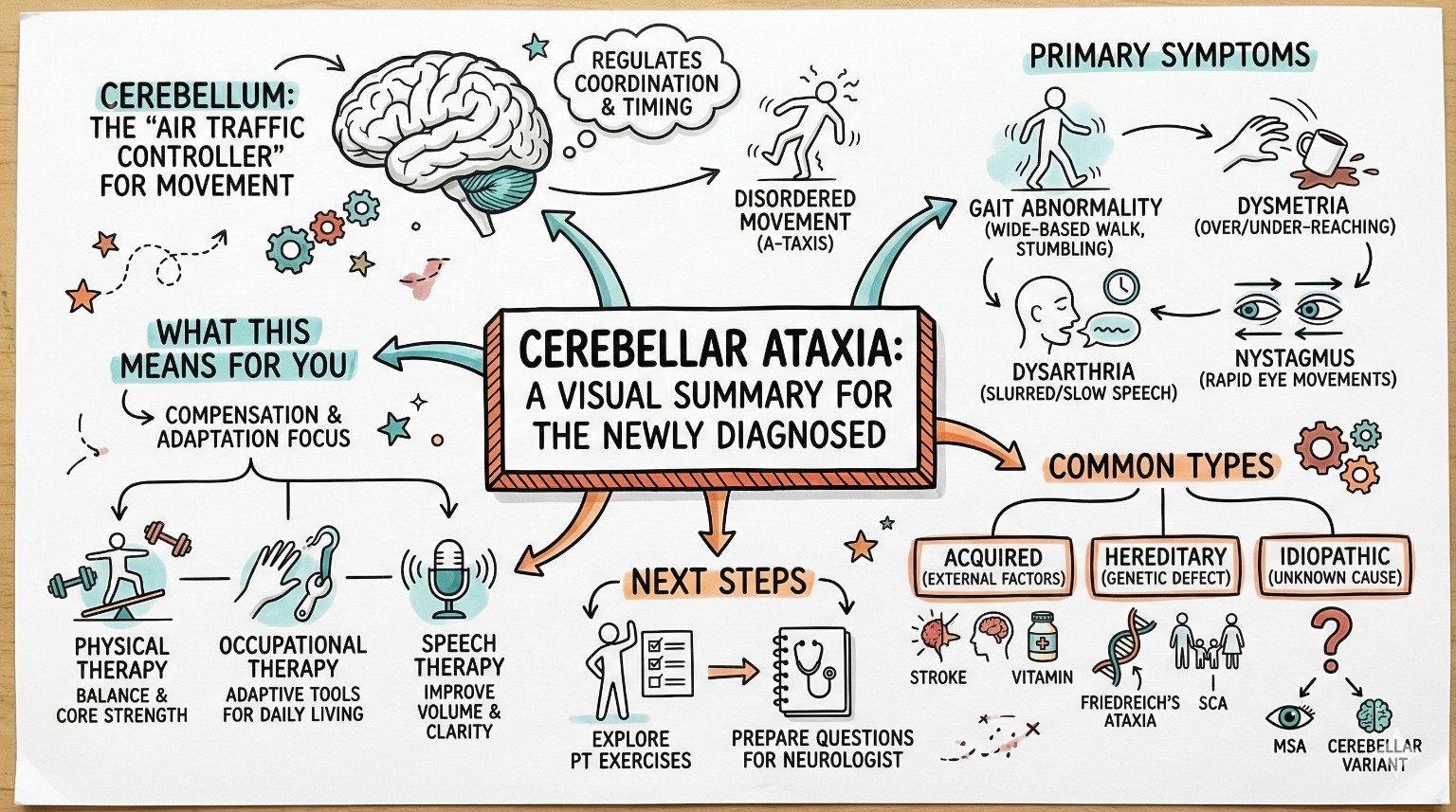
Ataxia may affect walking, balance, hand movements, speech, swallowing, or eye movements. It can be inherited or acquired, sudden or gradual, and stable or progressive.
Because causes differ, a careful medical evaluation matters. Testing may include a neurological examination, imaging, blood work, genetic testing, or other studies based on the history.
My diagnosis is idiopathic cerebellar degeneration attributed to an autoimmune condition involving CASPR2. It is an ultra-rare disease with ~1000 cases worldwide.
NEWLY DIAGNOSED
A visual overview of the cerebellum, common symptoms, broad causes, rehabilitation roles, and useful next steps.
SPINOCEREBELLAR ATAXIAS
Each numbered SCA is tied to a different genetic change. They overlap in balance, coordination, speech, and eye-movement problems, but differ in typical age of onset, other affected systems, and average rate of progression.
The number is a label, not a severity ranking. Two people with the same SCA can still have different symptoms and timelines.
May include swallowing difficulty, spasticity, neuropathy, weakness, and abnormal eye movements.
Often overlaps with SCA1 and SCA3; neuropathy, reduced reflexes, tremor, or parkinsonism may occur.
Also called Machado–Joseph disease. Spasticity, dystonia, neuropathy, eye-movement changes, or parkinsonism may accompany ataxia.
Commonly begins later and progresses more slowly on average. Vertigo or episodic symptoms may occur in some families.
Retinal degeneration can cause color and central-vision problems, sometimes before obvious coordination changes.
Movement changes can occur with cognitive, psychiatric, dystonic, parkinsonian, or seizure symptoms.
Why testing matters: Symptoms overlap too much to identify an SCA reliably by examination alone. Genetic testing—often including repeat-expansion testing—is usually needed to confirm the type.